
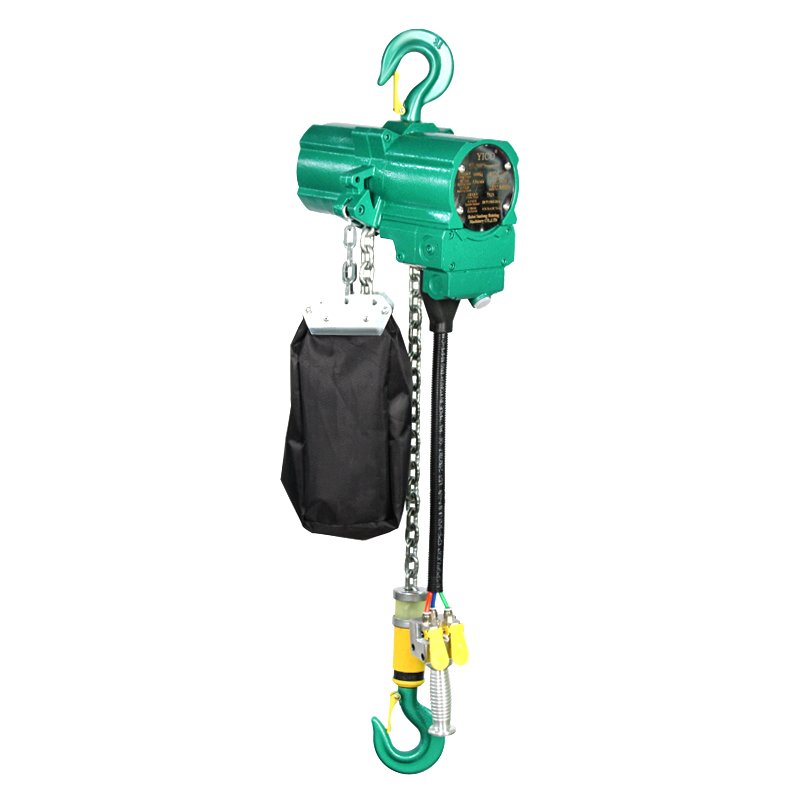
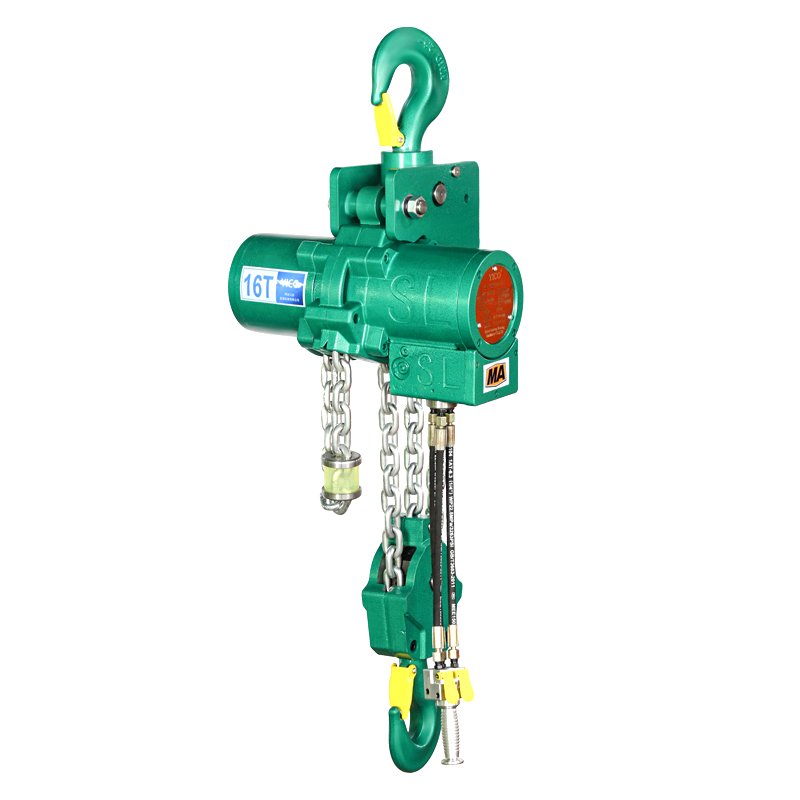
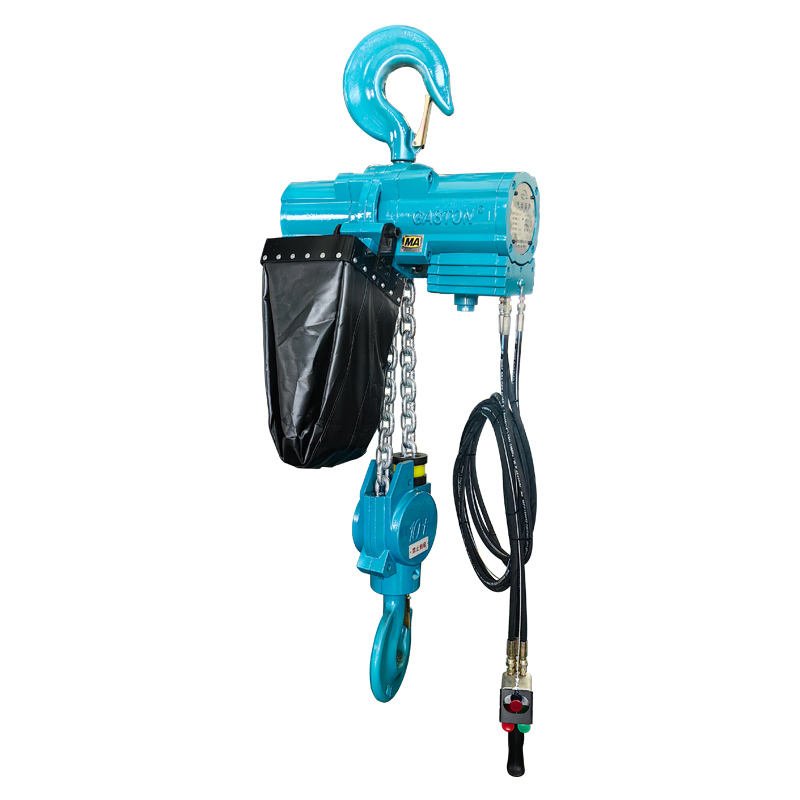
Explosion Proof Pneumatic Hoist for Coal Mine, Heavy-Duty Lifting Hoist with Explosion Protection
Ⅱ. Main Types and Characteristics
1. Classified by Lifting Medium
-
Chain Pneumatic Hoist: Compact structure, light weight, and large lifting height, suitable for general lifting operations.
-
Steel Wire Rope Pneumatic Hoist: Strong load-bearing capacity and stable operation, suitable for long-distance and high-precision positioning operations.
2. Classified by Motor Type
-
Vane-type Pneumatic Hoist: Quick start and sensitive speed regulation, suitable for frequent start-stop working conditions.
-
Gear-type Pneumatic Hoist: Large torque and strong durability, suitable for heavy-load and continuous operation scenarios.
Ⅲ. Unique Advantages and Features
-
Intrinsic Explosion Proof: No electric sparks are generated, making it suitable for flammable and explosive environments such as chemical industry, petroleum, and coal mines, which is its core advantage.
-
Stepless Speed Change: The lifting speed can be precisely controlled by adjusting the air flow, reaching 3 times that of electric hoists and 5-10 times that of manual hoists.
-
Strong Continuous Operation Capacity: It can work continuously for 24 hours without failure after 400 hours of fatigue testing.
-
Wide Adaptability:
-
Temperature range: -20°C to +50°C
-
Resistant to humid, dusty, and corrosive environments
-
No electromagnetic interference, suitable for electronic precision instrument workshops
-
-
Safety and Reliability: Double protection of air failure protection and overload protection, with low failure rate.
-
Environmental Protection and Pollution Free: Compressed air is directly discharged, with no risk of oil leakage, suitable for food and pharmaceutical industries.
-
Easy Maintenance: Simple structure, few wearing parts, and users can replace accessories by themselves.
Ⅳ. Typical Application Fields
-
High-risk Explosion-proof Industries: Petrochemical industry, underground coal mines, natural gas stations, paint spraying workshops.
-
Continuous Production Industries: Automobile manufacturing, home appliance production lines, tractor assembly lines.
-
Special Environment Operations: Shipbuilding and repair, offshore platforms, clean workshops in food and pharmaceutical industries, electronic factories.
-
Logistics and Warehousing Fields: Heavy cargo handling, automated warehouses, port loading and unloading.
-
Maintenance and Repair Operations: Overhaul of large equipment, maintenance of railway locomotives, aircraft manufacturing and maintenance.
An Introduction to Pneumatic Hoists
A pneumatic hoist is a lightweight and compact lifting device powered by compressed air. It converts the pressure energy of compressed air into mechanical energy through a pneumatic motor to achieve the lifting and horizontal movement of heavy objects. Due to its unique safety and environmental adaptability, it plays an irreplaceable role in special industrial environments such as flammable, explosive, humid, and dusty areas.
 ··
··I. Basic Definition and Working Principle
Definition
A pneumatic hoist is a lifting equipment that uses compressed air to drive a pneumatic motor, transmits power through a reduction mechanism, and lifts heavy objects via chains or steel wire ropes. Its load-bearing capacity typically ranges from 250 kilograms to 30 tons, and special models can reach up to 100 tons.
Working Principle
-
Compressed air enters the pneumatic motor through a manual control valve, driving the internal vanes/gears to rotate at high speed.
-
The planetary gear reducer converts high speed and low torque into low speed and high torque.
-
Power is transmitted to the sprocket/drum, driving the chain/steel wire rope to lift or lower the heavy object.
-
The air failure protection device automatically locks when air supply is suddenly cut off to prevent the heavy object from falling.
-
It can be used with a pneumatic or manual trolley to realize horizontal movement.
Reviews
There are no reviews yet.